
Circular Planet Institute’s Verified Circular-Regenerative (VCR) Certification Mark Receives USPTO Notice of Allowance
A productivity-centered certification approach seeks to redefine how agricultural sustainability is measured, verified, and rewarded using AI-enabled technology and external auditors.
By Circular Planet Institute (CPI)
The Circular Planet Institute (CPI) is pleased to announce an important milestone in advancing circular-regenerative agriculture: its Verified Circular-Regenerative (VCR) Certification Mark, USPTO Serial No. 99679198, received notice of allowance by the United States Patent and Trademark Office (USPTO).

This milestone represents a significant step toward the commercial introduction of the certification framework designed to address one of the most important gaps in agricultural sustainability: the need to connect environmental responsibility with measurable agricultural productivity and resource-use efficiency.
At the heart of the VCR Certification Program is a different way of thinking about agricultural. Rather than focusing exclusively on whether farmers adopt sustainable or regenerative practices, VCR places farm-level productivity at the center of certification.
Its guiding principle is simple but transformative:
How efficiently does a farm use agricultural inputs to produce valuable outputs while applying circular and regenerative practices that contribute positively to nature and minimize negative environmental impacts?
CPI believes this question should become central to how agricultural productivity and sustainability are evaluated, recognized, and rewarded.
Moving Beyond Conventional Agricultural Certification
Agricultural certification has played an important role in promoting responsible production, environmental stewardship, and sustainable sourcing. Various certification schemes address important areas such as organic production, regenerative farming, carbon management, biodiversity, water stewardship, and responsible agricultural practices. However, many certifications approaches primarily emphasize compliance with established requirements or the adoption of specified practices.
While these approaches are valuable, they do not always provide an integrated assessment of how efficiently agricultural production systems utilize their resources, how effectively they minimize resource losses, or how their production activities contribute to restoring the natural environment.
For example, adopting regenerative farming practices does not automatically mean that a farm is efficiently utilizing its fertilizer, water, energy, and other production inputs. Similarly, recycling agricultural waste does not necessarily mean that the farm is improving soil health, protecting biodiversity, or reducing its overall environmental footprint.
CPI recognizes that agricultural sustainability requires these dimensions to be considered together and most importantly, the outcomes must be useful to the farmer and their buyers and financial investors.
The VCR Certification Program therefore introduces an integrated framework that brings agricultural productivity, circularity, and ecological regeneration into one certification approach with AI-enabled platform that simplifies the whole process with even more transparency.
Its ambition is to move the conversation from simply asking whether a farm follows sustainable practices to understanding whether its production system is becoming more efficient, circular, regenerative, and environmentally responsible. The VCR certification has three distinct features such as 1) productivity centered, 2) deployed on AI-enabled platform, and 3) CVR recommendation decisions are based on external auditors. These unique features hat set it apart from traditional certification programs.
Productivity as the Foundation of VCR Certification
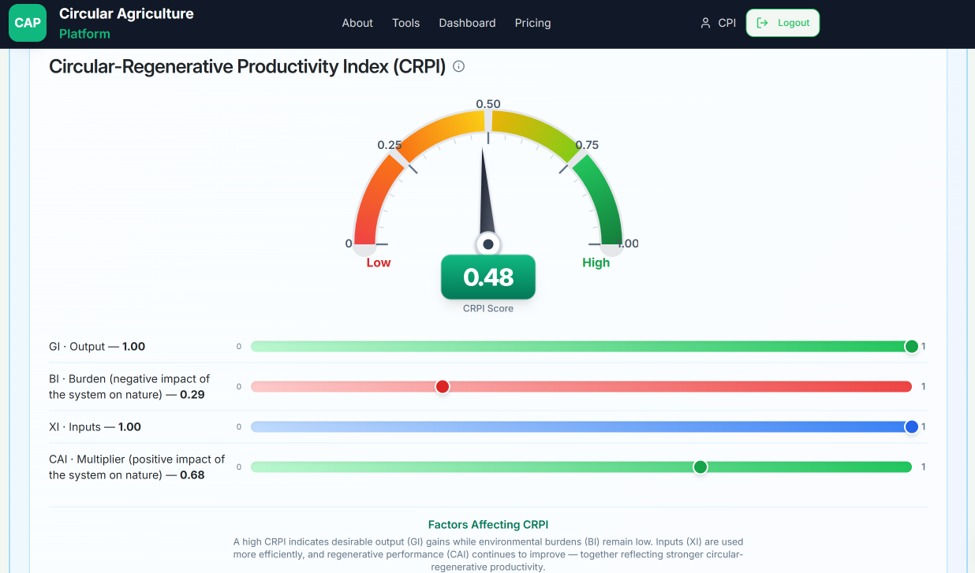
A defining feature of the VCR Certification Program is its foundation in a Circular-Regenerative Productivity Score.
The score provides the basis for evaluating farm-level efficiencies in converting agricultural inputs into productive outputs while considering the contribution of circular and regenerative practices to environmental performance.
Agricultural productivity should not be measured simply by the quantity of crops or livestock produced. It should also account for the resources consumed in producing those outputs, the efficiency with which those resources are utilized, and the environmental consequences of production. The Circular-Regenerative Productivity Score brings four interconnected dimensions together:
1. Input-to-output efficiency
This dimension evaluates how effectively a farm converts its production inputs and available resources into agricultural outputs. It considers the utilization of land, water, energy, fertilizers, crop protection products, and other agricultural resources.
The objective is to identify opportunities to improve resource-use efficiency, optimize input utilization, minimize losses, reduce unnecessary costs, and improve productive performance.
2. Circularity and regenerative practices
This dimension evaluates how agricultural practices contribute to resource circularity and ecological regeneration. It considers opportunities to close nutrient loops, recover and reuse resources, valorize agricultural by-products, minimize waste, improve soil health, conserve water, and support biodiversity. These practices help reduce dependence on external resources while strengthening the natural systems that sustain agricultural production.
3. Environmental impacts and contributions to nature
This dimension considers how agricultural production affects the environment and how farming practices can minimize negative impacts while contributing positively to nature.
Relevant considerations include soil degradation, water pollution, greenhouse gas emissions, resource depletion, biodiversity loss, and improvements in ecological functions. By integrating these dimensions, VCR seeks to recognize farms that demonstrate a more efficient use of resources, improved production performance, and responsible environmental stewardship.
4. Economic and social resilience of farmers and communities
VCR also considers how the productivity gains through the circular-regenerative practices with efficiencies that contribute to positive environmental impact translates into improving the economic and social resilience of the farm and their community for a more food secured future.
The fundamental distinction is that VCR does not simply certify the adoption of sustainable practices; it seeks to certify the productivity and environmental performance of the agricultural production system.
This creates a stronger connection between farm profitability, resource efficiency, and ecological outcomes.
Technology-Enabled Measurement Through the Circular Agriculture Platform
Another important differentiator of the VCR Certification Program is its integration with CPI's Circular Agriculture Platform (CAP).
CAP provides the digital infrastructure for collecting, organizing, monitoring, and evaluating farm-level agricultural sustainability and productivity information.
The integration of VCR with CAP is intended to make certification simply and more than a periodic compliance exercise. It connects farm-level assessment with digital measurement, performance tracking, and opportunities for continuous improvement.
Through the platform, relevant agricultural information can be used to evaluate production practices, resource utilization, and environmental performance while identifying opportunities to improve farm operations.
The VCR assessment framework addresses key areas of agricultural management with AI-recommendations in areas to improve, including:
Soil health
Water stewardship
Nutrient management
Biodiversity
Energy use
Integrated pest management
Agricultural waste management
Social impacts such as resilience

These areas are considered interconnected components of the overall production system. The most interesting innovation is that when you take your baseline assessment you do not qualify, our AI-platform gives you recommendations on the areas of the farm and practices you should pay attention to for improvement.
External Independent Auditors
A key and central part of the VCR certification program is the partnership with trained external auditors who makes the certification recommendation based on actual field visits to validate farm practices and products. The external auditor’s program is an independent external verification, including farm-level assessments, documentation reviews, and examination of relevant agricultural information to support the credibility of their certification recommendation decisions.
This combination of science-based assessment, digital infrastructure, and independent verification provides the foundation for a transparent and accountable certification process.
Creating Tangible Value for Farmers and Food Systems
CPI believes that sustainability certification should create value for farmers, not simply introduce additional compliance requirements.
Farmers increasingly face demands from food companies, retailers, financial institutions, and consumers to demonstrate their environmental and sustainability performance. However, collecting and reporting sustainability information does not always translate into improved productivity, lower production costs, better market access, or financial benefits for farmers.
The VCR program seeks to help change this relationship. By placing productivity at the center of certification, VCR aims to help farmers identify inefficiencies, improve input utilization, reduce resource losses, strengthen farm resilience, and demonstrate the environmental value of their production systems.
For food companies and retailers, VCR offers an opportunity to engage suppliers through an integrated circular-regenerative framework while improving transparency in agricultural sourcing.
For agricultural lenders and insurance providers, verified information about farm-level production practices, resource efficiency, and environmental performance could complement existing approaches to evaluating agricultural risks and resilience.
For consumers, digital access to relevant farm-level impact information can provide greater insight into how agricultural products are produced.
Ultimately, CPI envisions a system in which sustainability information becomes useful for improving farm productivity, strengthening commercial relationships, supporting better financial decisions, and rewarding responsible agricultural production.
Market Transparency and Accountability Through Certification
The VCR Certification Mark is designed to provide a recognizable means of identifying agricultural producers and eligible products that meet CPI's established certification requirements. The certification infrastructure is intended to incorporate QR-enabled access to relevant farm impact reports and a public registry of verified participants.
These mechanisms can help connect certification claims with supporting information, giving buyers and consumers greater opportunities to understand the agricultural production systems behind certified products.
Annual certification renewal is also intended to encourage continued assessment and improvement rather than treating certification as a one-time achievement.
For CPI, the objective is to establish a credible connection between agricultural production, independently verified performance, and market recognition.
The USPTO notice of allowance milestone is an important step toward establishing the intellectual property foundation for the VCR Certification Mark and advancing its commercial offering. The allowance milestone now allows the certification use commercially around the globe.
The future of agricultural productivity must be circular. It must be regenerative. And its performance must be measurable and verifiable.
Start Your CVR Journey Today As a Farmer Using the Steps Below
Step 1: Complete your free farm assessment at Circular Agriculture Platform to determine your eligibility and get recommendations on how to qualify
Step 2: Complete and submit a formal VCR application using this producer intake form
Step 3: CPI Team will review your application after you submit them and follow up on next steps once eligibility is established (assign auditor, auditor visit you for review and make recommendation for certification, you receive official VCR letter and logo, use the certificate according to the standard guidelines).
Start Your CVR Journey Today As a External VCR Auditor by completing the application form below
Apply to be VCR External Auditor in your area using the link below
If you need support, reach out at info@circularplanetinstitute

Comments