
Total Factor Productivity (TFP) Is a Mirage - Unsustainable Faltering Global Agriculture
- Dr. Isaac Mpanga

- 5 days ago
- 4 min read
Total Factor Productivity (TFP) has long been treated as the gold standard for measuring agricultural progress. Governments, donors, and global institutions rely on it to judge whether the world is “on track” to feed 10 billion people. But the evidence—across global, regional, and farm‑level data—shows that current TFP looks like a mirage. It rewards systems that expand output while ignoring the ecological collapse beneath them. It celebrates efficiency gains even when those gains are built on degrading soils, polluting waters, biodiversity loss, and massive food waste and loss. TFP, in its current form, is not only incomplete, but it could be misleading, pushed the world toward a fragile, high‑input agricultural model that may not sustain itself in the future.
According to the GAP Report by Virginia Tech University based on USDA Economic Research Data from 2022,
The world needs 1.73% annual TFP growth to double food production by 2050 without increasing inputs.
Actual global TFP growth is only 1.36% with low‑income countries having negative TFP growth (–0.31%), meaning they are losing productive capacity. High‑income countries show only 0.82% growth—far below sustainability thresholds.
Meanwhile, upper‑middle‑income countries, especially in Latin America show higher TFP growth (1.83%), but this is driven by heavy fertilizer use, irrigation expansion, and land conversion, not a natural resources efficiency (Salazer et. al., 2026). TFP growth is input‑driven, not innovation that creates resilience and profitability to the farmer and health to consumers and nature.
The Hidden Ecological Debt Behind Current Global Agriculture that is missing in TFP
The world’s food system is already operating beyond planetary boundaries with high impact on nature coupled with high inefficiencies. These are not side effects—they are the hidden inputs behind global TFP growth called “hidden ecological debt”. The current TFP accounts for land, labor, fertilizer, and machinery but does not account for soil organic matter loss, nutrient runoff or leaching, biodiversity collapse, water depletion, greenhouse gas emissions, and food waste. The result is a metric that inflates productivity by ignoring the true costs of food production-no attention to natural resources supporting production.
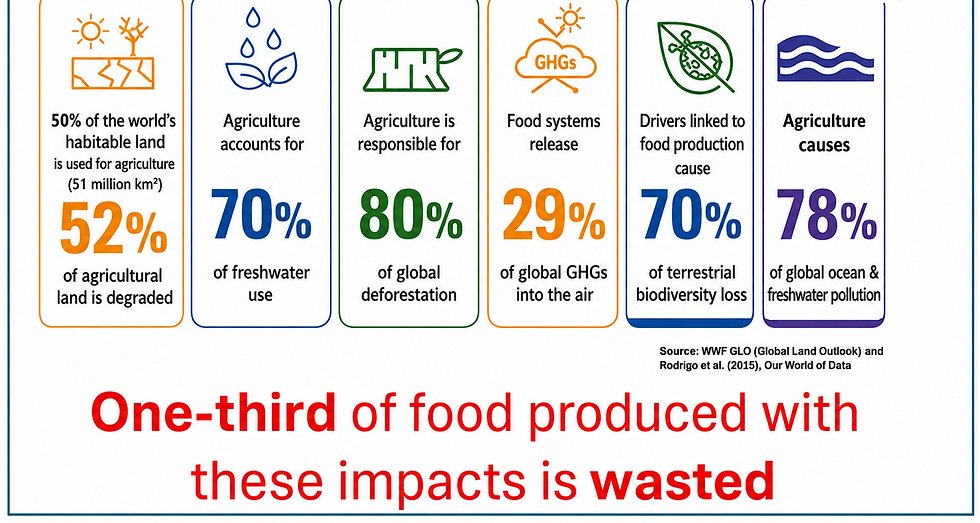
The global food system wastes one‑third of all food produced food grown. TFP does not penalize waste, does not reward circularity, and does not measure efficiency of natural resource use. This means a system that produces more food and wastes major portions can still show high TFP growth. The real productivity crisis is not yield in output but rather inefficiency, leakage, and waste.
A recent study in the United States published in Nature Sustainability by Zhou et. al. in 2026 shown that human and animal waste in the country that ends up in landfills can provide 102% of nitrogen and 50% phosphorus required for all production in the country and can by economically distributed to those production areas.

The only limitations are lack of right policy and infrastructure, but the question remains why it is not the priority but still focus on synthetic inputs that have increased by about 70 to over 100% in the past two decades.
“The productivity issue in our food systems cannot be solved by more production as has been the anthem but rather by increasing efficiencies using closed loop systems that reduces waste and pay close attention to natural resources use.”
What business or sector on this planet wastes 1/3 of its output that does not reach consumers and remain a viable business? Agriculture waste 1/3 of its output and remains in business because we all must eat and guess who is paying the price –
the farmer: declining profitability leading to decline farming businesses and less interest in farming by the younger generations
nature: increasing biodiversity losses, soil degradation, water pollution and drying rivers, emissions, etc.
all of us: highly dependent on highly processed unhealthy food that affects our health
Latin America Case Study on TFP indicates and faltering agricultural boom
A recent study by Salazer et. al. (2026) demonstrate Latin America’s agricultural “growth” TFP celebrates as boom may be illusion. When ecological costs are factored into the equation, the boom becomes a bust in slow motion.

Agricultural productivity growth in Latin America showing difference between input-driven and sustainable growth (Salazer et. al., 2026)
Production increased 6× from the 1960s to early 2000s.
From 2010–2020, 40% of growth came from TFP, but 60% came from more land, water, and fertilizer.
When environmental costs are included, productivity growth falls by more than half. We cannot improve what we do not measure, so excluding important key natural resources metrics from important measurement tool like TFP is in itself a hindrance to a sustainable and resilient food future.
New Sustainable Productivity
A sustainable productivity metric must integrate soil health, water efficiency, nutrient circularity, biodiversity function, carbon balance, food loss, ecosystem regeneration. This is the foundation of Circular-regenerative Agriculture promoted by the Circular Planet Institute. Circular-regenerative Agriculture is a system where output becomes inputs, waste becomes value, and productivity is measured by resource efficiency and ecosystem renewal with linkages to consumers and boundaries such as farm, community, regional, and national (Mpanga 2023).
Circularity is not an environmental add-on but rather a true engine for long‑term productivity.
The proposed Sustainable Productivity Index (SPI) by Salazer et. al. 2026 is in the right direction. The SPI includes both desirable & undesirable outputs as the numerator and inputs as the denominator.
1) desirable output index (GI): Agricultural production of crops and livestock.
2) undesirable output index (BI): Negative environmental impacts.
3) input index (XI): Use of agricultural inputs.
Conclusion
Current TFP is a mirage— promotes a fragile, high‑input agricultural model that is degrading the very resources it depends on. The metric rewards short‑term output while masking long‑term decline, which should evolve to reflect total output (desirable and undesirable). A productivity metric should factor actual realities; hence, food requires a new productivity paradigm like the SPI—one rooted in circularity, regeneration, and ecological efficiency, not the illusion of high‑input productivity.

To ensure SPI and the like use on a regular basis with ease in agriculture systems, planning, implementation, and reporting tool like Circular Agriculture Platform (CAP) should adapt and integrate in the tool as a key metric for farm, projects, and even field level productivity measurement.


Comments